


This hand-coloured impression of plate ten comes from a set of the Paris prints that was sold in 1947 when they were listed in the sale catalogue ‘as soft-ground etchings, before the aquatint ground was added, coloured by the artist’ (Sotheby’s, 5 March 1947, lot 454). The colouring is of no great quality and were it not for the provenance I would in all likelihood have suggested that the washes were added to the etching by an amateur working from the published aquatints. However, knowing that this set of prints came from the collection of Richard Ford (1796–1858) who inherited the presentation set of hand-coloured outlines (see TG1876a figure 1) from the Earl of Essex makes an attribution of the watercolour washes to Girtin plausible if not entirely convincing. John Girtin’s subscription list for the prints notes that in addition to buying the ‘Paris Drawings’ for £50 the Earl of Essex also paid for two sets of proofs and a set of the etchings.1 The extra sum paid for the etchings suggests that they may have been enhanced, though this might have been the work of John Girtin.

1802
The Porte Saint-Denis, Viewed from the Suburbs: Possible Colour Study for Plate Ten of Picturesque Views in Paris
TG1877
1802
The Porte Saint-Denis, Viewed from the Suburbs: Possible Colour Study for Plate Ten of Picturesque Views in Paris
TG1877

1802
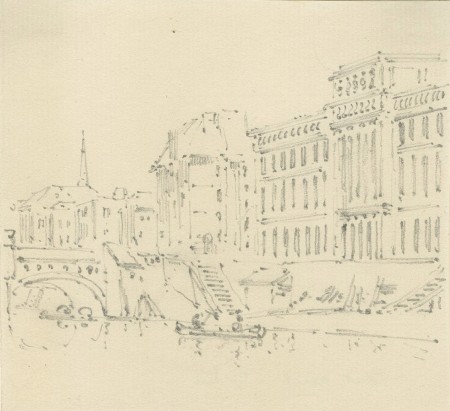
The Pont au Change, the Théâtre de la Cité, the Pont Neuf and the Conciergerie Prison, Taken from the Pont Notre Dame: Colour Study for Plate Nine of Picturesque Views in Paris
TG1876a




About this Work
This view of the seventeenth-century triumphal arch known as the Porte Saint-Denis, seen from the Rue du Faubourg-Saint-Denis, was coloured by Girtin working over a soft-ground etching (see print after TG1877), which, in turn, may reproduce a pen and ink study (TG1877). Girtin’s normal practice when working on the production of the twenty aquatints that formed his Picturesque Views in Paris and Its Environs was to colour the outline in simple monochrome washes for the guidance of the professional engraver, in this case Frederick Christian Lewis (1779–1856), to aquatint the artist’s plate (see print after, above). The full colour used here to work up the soft-ground etching for plate ten means that it is not clear whether this was the case with this drawing or whether one of the other hand-coloured etchings was the model created for Lewis to work from. The issue has been complicated by the fact that the set of Girtin’s working drawings owned by Francis Russell, 7th Duke of Bedford (1788–1861), did not include a colour study for plate ten, and it is the provenance of the hand-coloured etchings that helps considerably with an understanding of their function. For instance, we know that Girtin produced a second set of hand-coloured impressions of his etchings that were carefully mounted and sold by John Girtin (1773–1821) to the dedicatee of the publication, George Capel-Coningsby, 5th Earl of Essex (1757–1839) (see figure 1), and so one of the coloured etchings of Porte Saint-Denis, at least, can be ruled out as being the working study made for Lewis. But, in the absence of more complete details, the precise function of the other two hand-coloured prints remains uncertain, and it is even possible that neither fits the bill as the model for Lewis’ work.