- Description
-
- Creator(s)
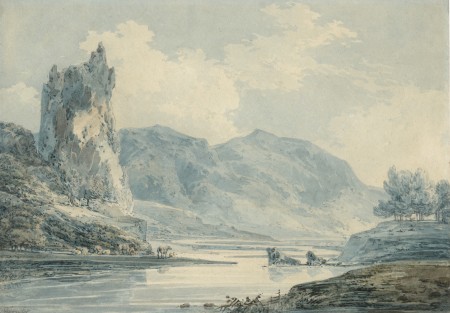
- Thomas Girtin (1775-1802) and Joseph Mallord William Turner (1775-1851) after (?) Edward Dayes (1763-1804)
- Title
-
- Borrowdale: The View from Rosthwaite
- Date
- 1794 - 1797
- Medium and Support
- Graphite and watercolour on wove paper
- Dimensions
- 16.2 × 24.5 cm, 6 ⅜ × 9 ⅝ in
- Object Type
- Collaborations; Monro School Copy
- Subject Terms
- Hills and Mountains; The Lake District
-
- Collection
- Catalogue Number
- TG0807
- Description Source(s)
- Colour photograph
Provenance
Dr Thomas Monro (1759–1833); his posthumous sale, Christie's, 26–28 June and 1–2 July 1833 (day and lot number not known); ... Earls of Warwick (their collector's mark, lower right), probably George Guy Greville, 4th Earl of Warwick (1818-93); by descent to the 1920s; Thos. Agnew & Sons; ... Christie's, 25 April 1995, lot 93 as 'Cottages in a River Valley in the Lake District' by Edward Dayes; Leger Gallery as 'Borrowdale' by Joseph Mallord William Turner; bought by Diane A. Nixon (1935–2024); her posthumous sale Sotheby’s, New York, 4 February 2026, lot 85 as by Joseph Mallord William Turner and Thomas Girtin, £15,240
Other entries in Monro School Copies:
British Views, Including Works after the Outlines of John Henderson

An Upland Landscape with a Rainbow, Said to Be Lowther Fells
Kendal Town Hall

Windsor Castle and Park with Deer
Yale Center for British Art, New Haven

Tonbridge Bridge and Castle
Yale Center for British Art, New Haven

The High Rocks, near Tunbridge Wells
National Gallery of Scotland, Edinburgh

The Town of Rye, Seen from the Marshes
Yale Center for British Art, New Haven

Dover Castle, Seen from the Beach
Yale Center for British Art, New Haven


Ullswater: Looking Towards the Head of the Lake
Tate, London

Unidentified Medieval Ruins, with Agricultural Buildings
Tate, London

A View near Keswick, Probably Bassenthwaite Lake
Private Collection

Skiddaw and Bassenthwaite Lake, from the Vale of Newlands
Private Collection

Looking South into Borrowdale, from the Shore of Derwentwater
Private Collection

Mountainous Landscape, Possibly in the Lake District
Walker Art Gallery, National Museums Liverpool

Boon Crag Cottage, with Coniston Water Beyond
Private Collection

A View in Cumbria, Probably Looking from Irton Fell towards Ravenglass
Clark Art Institute, Williamstown


A View in Cumbria, Looking towards Irton and the Irish Sea, with the Isle of Man in the Distance
Tate, London

The River Leven, Cumbria, Viewed from Penny Bridge
Tate, London

St John's Vale, Cumbria
Private Collection

The Lodore Falls
Yale Center for British Art, New Haven

Langdale Pikes
Private Collection

An Unidentified Bridge over a Stream, Possibly in North Wales
Private Collection

Derwentwater, with Skiddaw in the Distance
Eton College, Windsor

Beddgelert Bridge, North Wales
Private Collection

Nant Mill, Betws Garmon, North Wales
Clark Art Institute, Williamstown

A Mountainous River Landscape with a Bridge
Private Collection

Cynwyd Mill, near Corwen, North Wales
Private Collection

Conwy: The Town Walls from the South East
Tate, London

Raglan Castle: The Great Hall
Private Collection

A Mountainous Landscape with an Unidentified Bridge, Possibly in North Wales
Ashmolean Museum, University of Oxford

The Iron Bridge at Coalbrookdale
Private Collection

An Estuary, Possibly Dartmouth
Private Collection
Ilam Rock, Dovedale
Private Collection

Grasmere: Looking North West to Helm Crag
Private Collection

The Head of Lake Windermere
Rhode Island School of Design Museum, Providence

The Head of Derwentwater, with the Lodore Falls
Private Collection

Dover Harbour, with Shipping Being Overhauled
Tate, London

A Two-Master in Dover Harbour, with the Castle Beyond
Tate, London

Dover Harbour: A Ship Being Overhauled
Tate, London

A Boat on the Shore, near Shakespeare Cliff, Dover
Tate, London

Dover Harbour: Fishing Vessels, Their Sails Drying
Tate, London

Shipping in Dover Harbour, with the Castle Beyond
Tate, London

Ullswater: Looking South to the Head of the Lake
Private Collection

A General View of Dover Harbour, from the East
Tate, London


Dover Harbour: Small Boats by the Quay
Tate, London

Boats in Dover Harbour
British Museum, London

An Unidentified Waterfall
Yale Center for British Art, New Haven

A Ship under Repair in Dover Harbour
National Gallery of Ireland, Dublin

Borrowdale: The View from Rosthwaite
Private Collection

Figures on a Fishing Vessel in Dover Harbour
Private Collection

A Fishing Vessel with Hastings Beyond
Birmingham Museums & Art Gallery

Dover Castle from the Sea
Private Collection

A Beached Vessel in the Inner Harbour at Dover
Private Collection

Dover Harbour, with the Castle on the Hill
British Museum, London

Dover Harbour
Private Collection

Beached Vessels in Dover Harbour, the Castle in the Distance
Smith College Museum of Art, Northampton

A Ship Beached in the Harbour with Dover Castle in the Distance
Winchester College

Vessels Anchored in Dover Harbour, with the Castle Beyond
National Gallery of Scotland, Edinburgh

Warehouses with Shipping in Dover Harbour
Smith College Museum of Art, Northampton

Vessels in the Harbour at Dover, with the Castle Beyond
Private Collection

Dover Harbour, with the Cliffs Beyond
Tasmanian Museum and Art Gallery, Hobart

Vessels Moored in Dover Harbour
Private Collection

The Inner Harbour, Dover, with the Castle Beyond
Brighton Museum and Art Gallery

A Ship Drawn Up on a Beach Being Careened
Private Collection

Beached Fishing Vessels, Dover Harbour
National Gallery of Ireland, Dublin

Beached Fishing Vessels in the Harbour at Dover
Private Collection

Boats Anchored in Dover Harbour
Victoria and Albert Museum, London

Boats Anchored in Dover Harbour
Private Collection

Dover Harbour, with Fishing Boats at Low Tide
The High Museum of Art, Atlanta

Dover: The Harbour with Vessels
Fitzwilliam Museum, University of Cambridge

A Smack in Dover Harbour, Drying Sails, with the Old Church in the Distance
National Maritime Museum, Greenwich

Dover Harbour: A Boat under Repair
Private Collection

Fishing Boats at Low Tide, near Dover
Courtauld Gallery, London

Dover: Two Boatmen Standing by the Prow of a Brig
Private Collection

Dover Harbour
Private Collection

A Fisherman's Cottage, Said to Be at Dover
Yale Center for British Art, New Haven

The Hull of a Ship under Repair, with a Barge and Smaller Boats
Tate, London

A Boat-Builder’s Yard, Possibly on the River Medway
Fitzwilliam Museum, University of Cambridge

A Boat-Builder’s Yard, Possibly on the Medway
Private Collection

A Boat-Builder’s Yard, Possibly on the River Medway
Private Collection

A Boat-Builder's Shed, Possibly on the River Medway
National Gallery of Scotland, Edinburgh

A Boat-Builder’s Shed, Possibly on the River Medway, with a Fishing Boat with Drying Sails
Tate, London

The Coast, near Dover
The Higgins, Bedford

Folkestone Harbour
Chris Beetles Gallery, London

Beachy Head, Looking towards Newhaven
National Gallery of Scotland, Edinburgh

Beachy Head, Looking towards Newhaven
Ulster Museum, Belfast

Shakespeare Cliff, Dover
National Gallery of Ireland, Dublin

Beached Vessels in Dover Harbour, the Castle in the Distance
Ashmolean Museum, University of Oxford

Buildings on a Wooden Quayside
Private Collection

A Coast View with Chalk Cliffs, Probably from near Beachy Head
Ashmolean Museum, University of Oxford

A Small Boat under Repair by a Jetty
Private Collection

Dover: Snargate Street, Looking West
British Museum, London


Dartford High Street
Private Collection

Tonbridge Bridge and Castle
Fitzwilliam Museum, University of Cambridge

Rye, from the River Tillingham
National Gallery of Scotland, Edinburgh

Dover: Fishing Boats at Low Tide
Private Collection

Two Boatmen Caulking the Bows of a Beached Brig, Probably at Dover
Private Collection


Hastings: A Beached Fishing Boat
Private Collection

A Coastal Scene at Dover
Worthing Museum and Art Gallery

Mickleham Church
Tate, London

An Overshot Mill
Museum of Fine Arts, Boston

Dolbadarn Castle on Llyn Padarn
Clark Art Institute, Williamstown


Distant View of Dover Harbour, Seen from the Cliffs
Fitzwilliam Museum, University of Cambridge


Conwy Castle, from the East
Huddersfield Art Gallery

Harlech Castle, from the South
National Gallery of Ireland, Dublin

The High Street at Egham
Private Collection

A Packhorse Bridge
Rhode Island School of Design Museum, Providence

Boats in Dover Harbour
Leeds Art Gallery

A Dismasted Boat in Dover Harbour
Harvard Art Museums / Fogg Museum

Two Trees Overlooking a Meandering River
Private Collection

A Dilapidated Cottage
Private Collection

Cattle near a Farmhouse, Probably in the Lake District
Private Collection

Dover: Boats Anchored in the Harbour
Private Collection

A Coastal View near Dover, probably at St Margaret's, Cliffe
Private Collection

Dover: Beached Boats, with the Castle Beyond
Private Collection

Dover Harbour: The Stern of a Large Ship, and Smaller Vessels
Tate, London

The Town of Rye, Seen from the Marshes
British Museum, London
Footnotes
- 1 The full diary entry, giving crucial details of the artists’ work at Monro’s house, is transcribed in the Documents section of the Archive (1798 - Item 2).
- 2 The view was identified by David Hill (Sotheby's, New York, 4 February 2026, lot 85).
Revisions & Feedback
The website will be updated from time to time and, when changes are made, a PDF of the previous version of each page will be archived here for consultation and citation.
Please help us to improve this catalogue
If you have information, a correction or any other suggestions to improve this catalogue, please contact us.
About this Work
This view in Borrowdale in the Lake District, taken from near the village of Rosthwaite, was made at the home of Dr Thomas Monro (1759–1833), where Girtin and his contemporary Joseph Mallord William Turner (1775–1851) were employed across three winters, probably between 1794 and 1797. Their task, as they recalled to the diarist Joseph Farington (1747–1821), was to copy ‘the outlines or unfinished drawings of’ principally John Robert Cozens (1752–97), but other artists too, including Girtin’s master, Edward Dayes (1763–1804). The ‘finished drawings’ they were commissioned to produce were the result of a strict division of labour: ‘Girtin drew in outlines and Turner washed in the effects’. As the young artists reported, ‘They went at 6 and staid till Ten’, with Turner receiving ‘3s. 6d each night’ whilst ‘Girtin did not say what He had’ (Farington, Diary, 12 November 1798).1 The outcome of their joint labours was substantial, amounting to several hundred drawings of which at least twenty are Lake District scenes after compositions by Dayes.
Girtin made a number of copies of his master’s views of the Lake District during his apprenticeship, including Lake Windermere and Belle Isle (TG0078). Since he was never actually to travel to one of the country’s most popular picturesque regions, for artists as well as their patrons and customers, he continued to base his Lake District views on the works of others throughout his career. As with the numerous copies that Girtin and Turner created from compositions by Cozens, it was the slight sketches and outlines that Dayes made on his travels that were used as the source for their more finished watercolours. Monro’s posthumous sale, in 1833, contained several hundred of Dayes’ sketches, including seven ‘Views on the lakes, blue and Indian ink’ as well as views of ‘Keswick, Glanton, Patterdale’, all presumably made on his only documented visit to the Lakes in 1789, but there is no evidence that Monro owned any of the older artist’s studio works (Christie’s, 2 July 1833, lots 42 and 45). Typically, the Dayes source for this striking view in Borrowdale looking south-east into the Stonethwaite Valley, with the hills of High Knott and Eagle Crag visible in the distance, has not been traced, though this does not mean we should look elsewhere for its model.2 Few of Dayes’ sketches have survived and, arguably, the fact that no source can be found for this work suggests that it was a thoroughly unprepossessing drawing that required considerable transformational skills from the young artists.
Monro’s posthumous sale contained more than forty Lake District views, all of which were attributed solely to Turner (Christie’s, 26 June 1833; Christie’s, 1 July 1833). Unlike Girtin, Turner did visit the region, albeit briefly in 1797. However, whilst some of the items in the sale may have resulted from this trip, the majority were noted as being in ‘blue and Indian ink’ and they therefore employed the characteristic palette associated with the Monro School works. This was the colour range favoured by Dayes himself and perhaps not surprisingly this work was at one time attributed to Girtin’s master before it was given to Turner working on his own. The recent change to a joint attribution is to be commended as the typically rapid application of washes leaves much of Girtin’s pencil work visible, providing an attractive armature around which Turner creates a lucid sense of space.
1791 - 1792
Lake Windermere and Belle Isle
TG0078