- Description
-
- Creator(s)
- Thomas Girtin (1775-1802) after (?) Amelia Long, Lady Farnborough (1772-1837)
- Title
-
- Barns and a Pond, Said to Be near Bromley
- Date
- 1799 - 1800
- Medium and Support
- Graphite and watercolour on laid paper
- Dimensions
- 19.6 × 24.7 cm, 7 ¾ × 9 ¾ in
- Object Type
- Studio Watercolour
- Subject Terms
- Dover and Kent; Picturesque Vernacular
-
- Collection
-
- Private Collection, Norfolk
- (1-E-23)
- Versions
-
Barns and a Pond, Said to Be near Bromley (TG1418)
- Catalogue Number
- TG1419
- Girtin & Loshak Number
- 275i as 'View near Bromley'; '1798'
- Description Source(s)
- Viewed in 2001 and April 2022
Provenance
George Wyndham Hog Girtin (1835–1911), by 1861 (lent to London, 1875); by a settlement to his sister, Ida Johanna Hog Rogge, née Girtin (1834–1925), January 1880; sold by her to J. Palser & Sons (stock no.15473); bought by Sir Hickman Bacon (1855–1945), 1 April 1901; then by descent
Exhibition History
London, 1875, no.73 as 'View near Bromley, Kent'; London, 1946, no.90; Boston, 1948, no.132
Bibliography
List of Tax-Exempt Heritage Assets as 'Attributed to Thomas Girtin' (Accessed 14/8/2026)
Place depicted
Other entries in London and the Home Counties, Together with Miscellaneous Studies and Views

Windsor Castle, from the River Thames
Harvard Art Museums / Fogg Museum


Great Bookham Church, from the East
Private Collection, Norfolk


Windsor Park and Castle, from Snow Hill
Anglesey Abbey, Cambridgeshire (National Trust)


The Gateway, St Albans Abbey
Ashmolean Museum, University of Oxford

St Albans Abbey: The West Porch
Yale Center for British Art, New Haven

St Albans Abbey: The West Porch
Yale Center for British Art, New Haven

St Albans Abbey, from the North West
National Gallery of Canada, Ottawa
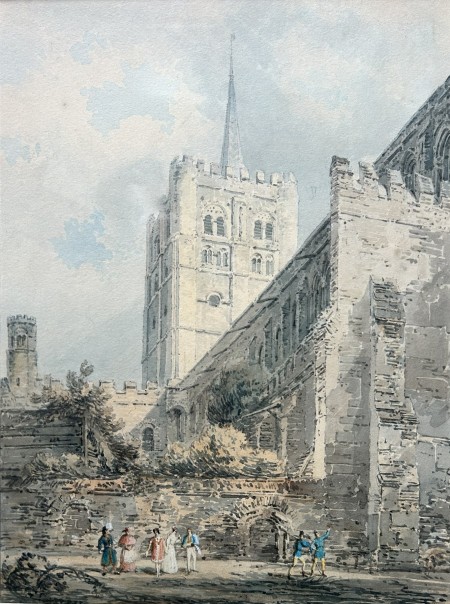
St Albans Abbey, from the North West
Private Collection


An Interior View of St Albans Abbey, from the Crossing
Art Gallery of South Australia, Adelaide

The Interior of St Albans Abbey
Blackburn Museum and Art Gallery

Windsor Castle and the Great Park, from the South West
Private Collection, Norfolk

Windsor Great Park: Herne’s Oak with a Herd of Deer
Yale Center for British Art, New Haven
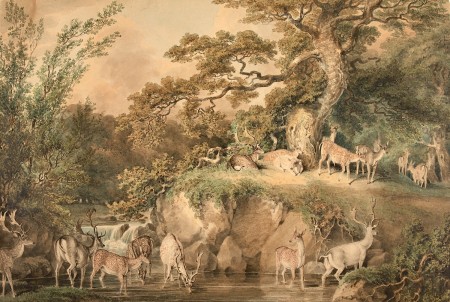

Stags Fighting amongst a Herd of Deer in Windsor Great Park, with the Castle in the Distance
Private Collection

A Herd of Deer in Richmond Park
Private Collection

A Panoramic View of the Thames from the Adelphi Terrace, Section One: Somerset House to Blackfriars Bridge
Private Collection

A Panoramic View of the Thames from the Adelphi Terrace, Section Two: The Surrey Bank
Private Collection

A Panoramic View of the Thames from the Adelphi Terrace, Section Three: Westminster Bridge to York Stairs
Private Collection

Westminster, from the West Corner of the Adelphi Terrace
Private Collection

The Thames with St Paul's and Blackfriars Bridge
The Morgan Library & Museum, New York

Shipping on the Thames, Looking down Limehouse Reach towards Greenwich, with the Church of St Alfege in the Distance
Private Collection


A Haystack on a Farm, on the Road to Harrow-on-the-Hill
Private Collection

A Panoramic Landscape, near Norwood
Private Collection

Westminster Abbey, Seen from Green Park and the Queen's Basin
National Gallery of Art, Washington

St Paul’s Cathedral, from St Martin’s-le-Grand
Yale Center for British Art, New Haven

St Paul's Cathedral, from St Martin’s-le-Grand
Untraced Works

St Paul’s Cathedral, from St Martin’s-le-Grand
Private Collection

St Paul’s Cathedral, from St Martin’s-le-Grand
Metropolitan Museum of Art, New York

A River Scene, with Boats
Victoria and Albert Museum, London

An Imaginary Coast Scene with the Horizontal Air Mill at Battersea
Private Collection

London: The Leathersellers’ Hall
British Museum, London

London: The Interior of the Ruins of the Leathersellers’ Hall
British Museum, London


Turver’s Farm, Radwinter
Yale Center for British Art, New Haven


A Farm with an Unidentified Windmill
Private Collection

Barns and a Pond, Said to Be near Bromley
Rhode Island School of Design Museum, Providence

Barns and a Pond, Said to Be near Bromley
Private Collection, Norfolk
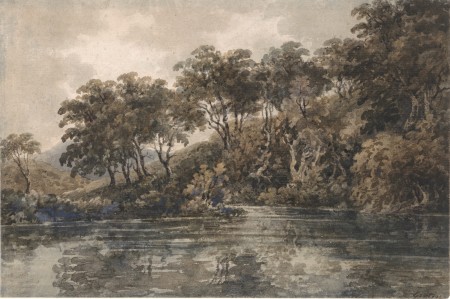
Trees and Pond, Said to Be near Bromley; A Slight Sketch of a Man
Yale Center for British Art, New Haven

A Sandpit, near Logs Hill, Widmore
Private Collection

A Sandpit, near Logs Hill, Widmore
Private Collection


The Church of St Mary the Virgin, Stone-next-Dartford
British Museum, London


A Farmhouse in a Woodland Setting, Said to Be in Devon
Yale Center for British Art, New Haven


Farm Buildings, Probably in Surrey
The Whitworth, The University of Manchester

Tintern Village, Seen across the Forge Pond, Formerly Known as ‘The Mill-Pond’
Private Collection

A Picturesque House Overlooking a River, with Distant Windmills
Sidney and Lois Eskenazi Museum of Art, Indiana University, Bloomington


The West End of an Unidentified Church
Private Collection

Effingham Churchyard, Formerly Known as 'A Country Churchyard'
Fitzwilliam Museum, University of Cambridge

An Unidentified Windmill, Probably in Lambeth
Sarah Campbell Blaffer Foundation, Houston


Unidentified Buildings, Herne Hill
The Huntington Library, Art Museum and Botanical Gardens, San Marino

Study of a Sailor on Board a Ship; A Fishing Boat
Private Collection


The Frozen Watermill, from William Cowper's The Task
The Huntington Library, Art Museum and Botanical Gardens, San Marino


An Unidentified Subject, Probably from James Macpherson’s Poems of Ossian
Tate, London

The Eruption of Mount Vesuvius
The Morgan Library & Museum, New York

The Archangel Gabriel Awaiting Night, from John Milton's Paradise Lost
Yale Center for British Art, New Haven


A Study of a Woman Reading; A Slight Study of a Seated Woman
Private Collection


Portrait Study of a Man, Said to Be the Artist George Barret the Younger
Private Collection


A Study of a Lion from the Tower of London
Private Collection


An Open Field with a Cart and Horses, Known as ‘The Carter’
British Museum, London

A Church Seen across Fields, with Another Sketch Depicting a Woman
The Huntington Library, Art Museum and Botanical Gardens, San Marino

A Landscape with Figures by Railings
Fine Arts Museums of San Francisco

Self-Portrait of the Artist at Work
British Museum, London

An Unidentified Landscape, with a Church amongst Trees
Yale Center for British Art, New Haven

A Cottage and a Windmill Surrounded by Trees
Private Collection

St Paul’s Cathedral, from the Thames
Fine Arts Museums of San Francisco

The Head of a Youth, Here Identified as Joseph Mallord William Turner
Ashmolean Museum, University of Oxford
Old London Bridge, with the Shot Tower in Construction, and St Olave's Church
Private Collection
Revisions & Feedback
The website will be updated from time to time and, when changes are made, a PDF of the previous version of each page will be archived here for consultation and citation.
Please help us to improve this catalogue
If you have information, a correction or any other suggestions to improve this catalogue, please contact us.
About this Work
The attribution to Girtin of this badly faded view of barns and a pond has been questioned, but, on balance, the work appears to be an autograph variation of a composition known from a slightly larger and more extensive watercolour (TG1418). Fine passages such as the reflections in the water and the characteristic treatment of the oak tree, comparable with one seen in a view on the river Ure (TG1692), suggest that the work is indeed by Girtin, and perhaps a little later than the date of 1798 suggested by Thomas Girtin (1874–1960) and David Loshak (Girtin and Loshak, 1954, p.171). The less compressed version is inscribed on the back ‘Bromley Church Kent’, and which though not in Girtin’s hand, seems to have established an improbable title for both compositions. Bromley was the home of one of Girtin's most prominent pupils and collectors Amelia Long, Lady Farnborough (1772–1837) and what has been identified as a copy of this composion has been attributed to her (see TG1418 figure 1). Another watercolour from the Long collection, known for a long time as ‘View near Bromley’ (TG1338), is more probably a scene in North Wales, whilst this work has more in common with the rural subjects Girtin produced from sketches made in the flat countryside of Essex, and specifically with A Mill in Essex (TG1416), which is in the same private collection in Norfolk. The crucial point is not whether the view is in Kent or Essex, however, as the scene is essentially a picturesque view of vernacular buildings, and a topographically specific title is, I suggest, inappropriate in any case.
On a technical note, the paper historian Peter Bower has described the support used by Girtin as an off-white laid wrapping paper manufactured by an unknown English maker, and he has confirmed that it comes from the same source that the artist used for Kirkstall Abbey (TG1635), Cottages at Hawes (TG1694), A Distant View of Guisborough Priory (TG1699) and A Mill in Essex (TG1416), all of which can be dated to 1799–1800 (Bower, Report). The use of the same paper for this work strongly suggests, therefore, that doubts about its attribution were primarily prompted by its poor faded condition. The technical evidence is arguably more important in establishing the work’s status than the fact that it seems to have come from the collection of the artist’s son, since not all of the watercolours owned by Thomas Calvert Girtin (1801–74) came from his father’s studio, and he also purchased works of varying degrees of authenticity on the open market.
I now think that the 'copy' by Amelia Long referred to above (TG1418 figure 1) is actually an original composition by her and that Girtin instead used her drawing as the source material for his two watercolours. A copyist would surely have followed closely Girtin's more compressed and unified composition and the more logical explanation for the differences between the work of the amateur and the professional is that Girtin took a drawing by his pupil and improved upon it as a lesson in compositional unity. Much as Girtin appears to have done with sketches by Sir George Beaumont (1753–1827) such as Borrowdale (see TG1582 source image) the professional used the work of an amateur as the basis of his own watercolour in a way that was instructional and which added to his own stock of subjects. Given that this drawing is more extensive one might conclude that it is TG1418 that is the more likely candidate for the work made for Amelia Long, therefore, and that this drawing is a further refinement of the source material.
1799 - 1800
Barns and a Pond, Said to Be near Bromley
TG1418
1800 - 1801
An Ancient Oak, Said to Be on the River Ure
TG1692
1799 - 1800
Barns and a Pond, Said to Be near Bromley
TG1418
1798 - 1799
An Unidentified Landscape, Possibly the Vale of Clwyd
TG1338
(?) 1799
A Mill in Essex
TG1416
1800
Kirkstall Abbey, from Kirkstall Hill
TG1635
1800 - 1801
Cottages at Hawes, from Gayle Beck
TG1694
1800 - 1801
A Distant View of Guisborough Priory; The Tithe Barn, Abbotsbury
TG1699
(?) 1799
A Mill in Essex
TG1416
1799 - 1800
Barns and a Pond, Said to Be near Bromley
TG1418
1799 - 1800
Borrowdale
TG1582
1799 - 1800
Barns and a Pond, Said to Be near Bromley
TG1418