

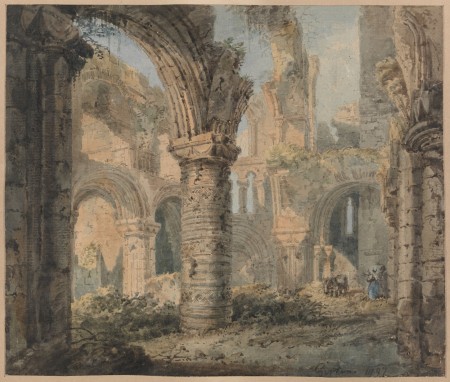
The work may have been exhibited at the Academy, but it is actually quite small in comparison with the other watercolours produced following the 1796 tour. The fact that this is not immediately evident from a reproduction is testament to the artist’s skill in creating a monumental composition from a ruin that itself is not particularly imposing. As Susan Morris has noted, the increasing drama of Girtin’s architectural views derived from the example of the etchings of Giovanni Battista Piranesi (1720–78), and she rightly states how the ‘massive, round columns of the Romanesque’ church at Lindisfarne ‘naturally suggested an analogy with Piranesi’s classical buildings’ (Morris, 1986, p.18). In the catalogue to the 2002 Girtin centenary exhibition, I rather casually suggested that copying Piranesi’s print The Arch of Janus (see source image TG0885) provided Girtin with the inspiration for adopting a low viewpoint and cropping the composition to the left, forgetting that the Lindisfarne view was made at least a year earlier (Smith, 2002b, p.70). Rethinking the issue twenty years later, it seems to me that although there are clear parallels between this work and a Piranesi view such as The Ruins of the Gallery of Statues at Hadrian’s Villa (see figure 3) from his Vedute di Roma (Views of Rome), perhaps this first stage of the great Italian’s influence on Girtin made itself felt more through the intermediating influence of John Robert Cozens (1752–97). Copying Cozens’ depictions of ancient classical monuments (such as TG0539) and Neapolitan scenes (such as TG0736) at the home of Dr Thomas Monro (1759–1833) arguably equipped Girtin to monumentalise the less impressive ruins of Lindisfarne when he got to visit the site at first hand in 1796.

1792 - 1793
Lindisfarne Priory Church, Looking West from the Choir
TG0210

1798
Warkworth Hermitage
TG1096

1799 - 1800
The Arch of Janus, Rome
TG0885

1794 - 1797
Rome: The Monumental Ruins of Nero's Golden House, the Domus Aurea
TG0539

1794 - 1797
Naples: Castel Sant'Elmo
TG0736






About this Work
This immersive view of the west end of Lindisfarne Priory Church, viewed from the north aisle of the nave, was painted in 1797 from an untraced sketch that Girtin made on his tour to the northern counties and the Scottish Borders in 1796. The isolated location of Lindisfarne, or Holy Island, off the Northumbrian coast, meant that despite the picturesque nature of the priory’s ruins and its association with the early Christian Church in Britain, relatively few tourists made the trip. Girtin’s earliest patron, the amateur artist and antiquarian James Moore (1762–99), was one who did, visiting in 1792, and the artist subsequently worked up one of his sketches of the subject (TG0210). There is no question that this work was copied from the drawing of an amateur, though; the complex perspective of the overlapping forms and voids would have required a professional’s skill, and I suspect that it was commissioned by Moore to represent a view that was beyond his artistic capabilities. It follows from this that Girtin may have visited Holy Island at his behest.
The watercolour was almost certainly one of the two works shown at the Royal Academy exhibition in 1797 with the title ‘St. Cuthbert’s Cathedral, Holy Island’ (Royal Academy, London, 1797, nos.434 and 763), and this is confirmed by the repetition of the idiosyncratic title on the back of the drawing possibly in Moore’s hand and by the prominent addition of a signature and date at the bottom right (see figure 1). Girtin very rarely dated his works at this time – just the two in 1797, for instance – and those that are thus inscribed tend to be exhibition pieces, such as Warkworth Hermitage (TG1096). When the drawing appeared glazed on the walls of the Royal Academy, it was likely to have been surrounded by a washline mount that, as an integral part of the watercolour, was produced by the artist himself. But as the fashionable way to display watercolours changed a later owner no doubt removed the original mount. Altogether, Girtin showed ten works at the 1797 exhibition, compared with none in the previous year, which is clear evidence that he had recently toured for the first time and that he had had some success in attracting commissions for his newly painted views. It must have been disappointing, therefore, that despite this he only attracted one review in the press and that it noted of his works that ‘though they possess considerable merit, it is evident that the Artist is careless in the detail and finishing’ (St. James’s Chronicle, 20 – 23 May 1797). Perhaps even more galling was the suggestion that ‘Mr. GIRTIN’S Drawings … appear to be formed on the style of TURNER’, especially as this complex internal view of the ruined priory at Lindisfarne seems to have inspired Turner to adopt exactly the same position when he visited the site a few months later (see figure 2).